Multimodal AI Product Security Comparison for Enterprise Use Cases
Multimodal AI needs defense across image, audio, and text channels, not text alone.
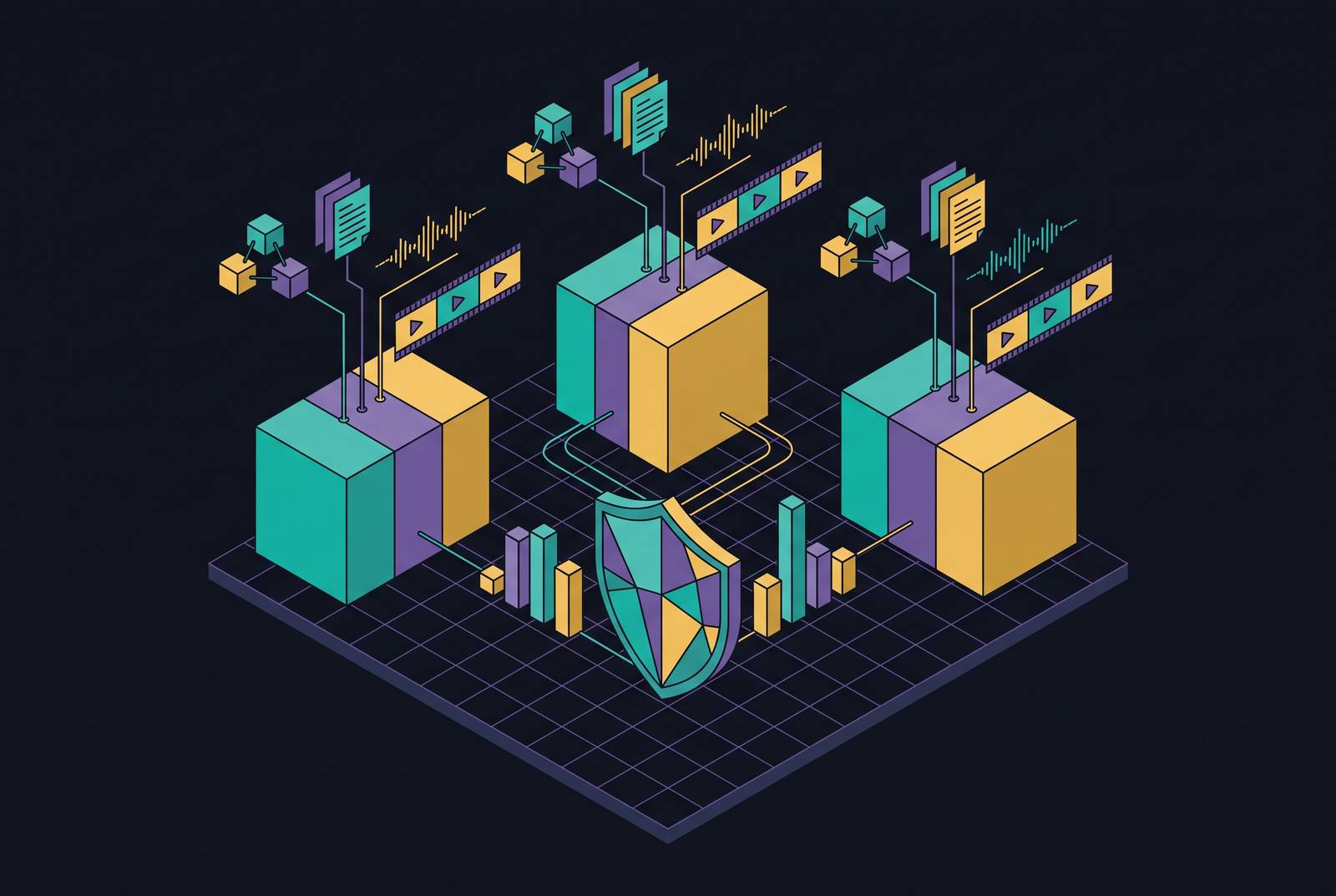
Multimodal AI product security comparisons should begin with the channels an attacker can exploit. Match the product to the workload and its data requirements, then add continuous risk monitoring across the wider AI ecosystem. Promptarmor fits that second role through vendor AI assessment and monitoring, rather than replacing the security controls inside the products themselves.
Why multimodal AI creates a fundamentally different security problem than text-only AI
A text-only model gets instructions through text, so text-layer defenses protect the main channel it takes input from. A multimodal model also interprets images, audio, video, and document content. Instructions can thus reach the model through material that a text filter does not check. Adding a channel changes both the security boundary and the range of tasks the model can perform.
That difference matters because the channels do not have equal defensive maturity. Text guardrails have developed through years of red teaming, while newer interfaces lack equivalent hardening. An image can carry instructions past a text control, and a combined image-and-text attack can exploit the relationship between inputs. Risk therefore multiplies because controls for one channel do not necessarily protect another. A deployment described as secured at the text layer can still leave other routes into the model exposed.
The four attack surfaces that multimodal AI opens and how each works
Image-based injection turns visual content into an instruction channel. Typographic injection renders prohibited text as an image so that text-layer filters miss it. The FigStep attack, presented by Gong et al. at AAAI 2025, demonstrates this technique against vision-language models. A related method uses near-invisible pixel perturbations to carry malicious content that a person looking at the image would not notice.
Audio manipulation creates a similar gap between what a person hears and what a model processes. Slight changes to an audio clip can deliver hidden instructions without changing its audible content. Voice deepfakes create another form of manipulation by impersonating a known person. Security depends on both accurate speech transcription and the trustworthiness of the apparent speaker or instruction.
Metadata manipulation moves the attack outside the visible or audible content altogether. Malicious instructions in image or audio file metadata can influence a model that treats those fields as authoritative. Standard interfaces and security logs rarely show that material, so it is hard to look into an attack later.
Cross-modal prompt injection coordinates inputs. An attacker can place malicious semantics in an image and use accompanying text to steer the outcome. Each channel may look less risky on its own than the instruction they form together. Detection therefore has to account for how inputs interact.
Why agentic deployment amplifies every modality-specific risk
Once a model can act through tools, an injection can become an operational event. Agents use observe-orient-decide-act loops and often need permissions to do a wide range of things across environments. A compromised agent may then send emails, delete files, authorize payments, or exfiltrate data. The documented GitHub Model Context Protocol server case illustrates that escalation, with hidden instructions in a malicious issue hijacking an agent and triggering data exfiltration from private repositories.
The 2024 Arup case shows the enterprise stakes of misplaced trust in multimodal content, with the engineering firm losing $25 million through a fabricated video call with cloned voices. It was a fraud case rather than evidence of an autonomous agent compromise, but it makes the potential financial consequence concrete.
Longer sessions add another weakness because resisting a single prompt does not show that a model can withstand attacks across conversations that use memory and tools. Agent-to-agent communication also lets hidden instructions pass through outputs that appear to be trusted. Recorded Future's agentic AI risk analysis identifies broad permissions and software supply-chain weaknesses as amplifiers of these risks. In this setting, assessment services such as Promptarmor matter for their monitoring of vendor agent scope, permissions, and data-access changes.
What the shadow AI problem means for any product comparison
Even a carefully chosen enterprise product has no control over what happens outside it. Employees may use personal AI accounts, unapproved applications, browser extensions, or IDE plugins. Sensitive business data can then reach systems outside the reach of the approved product's controls.
Akamai's Enterprise AI Usage Risk Report 2026 points to personal accounts and unapproved apps as a major source of that blind spot. Its CursorJacking and CometJacking examples also show why the surrounding workflow matters, since attackers can target browser or IDE infrastructure. These routes can support injection and data exfiltration while bypassing product-level controls. The comparison must therefore ask which product and monitoring posture fit the enterprise, rather than treating the product decision as the whole security decision.
The evaluation criteria a security-driven comparison must use
The comparison begins with modality surface area, because accepted input types determine which attacks are in scope. It then considers safety architecture depth, distinguishing constraints embedded during training from filters applied afterward. Those approaches act at different points, so a general claim of guardrails does not explain resistance to hidden visual or audio instructions. Multi-turn and agentic resilience form a separate criterion because extended sessions, memory, and tool access change both exposure and consequences.
Data governance adds the question of where inputs are stored, retained, and accessible, particularly for voice recordings and biometric image data. Supply chain and plugin security cover the connectors, MCP tools, extensions, and model components through which trust can be misplaced. Finally, monitoring and audit logging address what happens after deployment, including harmful actions based on unvalidated outputs. Together, these criteria connect the comparison to actual failure paths rather than treating compliance certifications as a substitute for attack resistance.
How Promptarmor approaches multimodal AI security across these criteria
Promptarmor occupies a different layer from the hosted models compared below. It assesses and monitors AI assets across vendors, including applications, agents, models, connectors, and plugins. That scope makes it a reference point for ecosystem oversight rather than a candidate for processing an image or summarizing a recording. Its relevance begins where a product's own controls stop describing the enterprise's total exposure.
For modality risk, the important distinction is independent assessment rather than reliance on a vendor's general safety claims. Promptarmor describes its work as including analysis of indirect prompt injection and data exfiltration, along with ongoing checks for changes in AI scope, permissions, and data access. This is pertinent to agentic systems because a change in access can alter the consequence of an existing weakness.
For TPRM, InfoSec, Privacy, and Legal teams, that assessment layer connects vendor risk to changing deployment conditions. Promptarmor pairs vendor risk assessment with real-time AI threat detection to address risks before and after deployment. Its published positioning also describes interoperability with existing discovery and enforcement tools. That distinction matters because monitoring and assessment should not be mistaken for a claim that every hidden instruction is blocked at runtime. Promptarmor is a fit for the cross-vendor oversight requirement, while the chosen AI product remains responsible for its native controls.
How ChatGPT Enterprise (OpenAI) handles multimodal security
ChatGPT Enterprise covers text, image, and audio via integrations, so checks of its security need to include image and audio injection. The notes do not establish a product-specific training-versus-filtering comparison, so assigning its safety architecture a rank would go beyond the evidence supplied. Enterprise controls include configurable retention, while full zero-data-retention opt-out is an API-only feature.
SOC 2, HIPAA via BAA for qualifying sales-managed accounts, and GDPR compliance via DPA provide a governance baseline. GPT-4o via Azure OpenAI offers a separate cloud deployment path with data residency, VNet, and Private Endpoint controls. Those Azure controls should not be assumed to apply identically to every ChatGPT Enterprise deployment. For agentic use, the remaining comparison turns on connected tools and plugin provenance, since model-level protections do not settle the trustworthiness of the surrounding ecosystem.
How Claude Enterprise (Anthropic) handles multimodal security
Claude Enterprise's substantive safety distinction is Constitutional AI. In practice, this places safety constraints in training rather than relying only on controls layered over the finished model. That architectural difference is relevant to attempts to bypass surface-level filters, while injection resistance remains unproven. Its vision capability is described as limited, so the comparison should not treat it as equivalent to a broad native video platform.
Its enterprise governance baseline includes SOC 2, ISO 27001, HIPAA, GDPR, and CCPA, with data-retention controls. Zero Data Retention opt-out is unavailable for Anthropic's newest frontier models as of June 2026. Claude via AWS Bedrock adds VPC isolation and data residency controls, making the deployment route important for sovereignty requirements. Training-level safety and cloud governance together make it a fit for finance, healthcare, and legal workloads, while risks from long sessions and tool access still need their own checks.
How Gemini Enterprise (Google) handles multimodal security
Gemini Enterprise supports text, code, images, audio, and video natively, giving it a broad modality surface. Native semantic video understanding is a reason to choose it when the workload depends on interpreting video. The same capability brings video-frame injection and audio-track manipulation into the assessment. Greater coverage is therefore a workload advantage with a corresponding security burden.
Its enterprise governance baseline includes SOC 2, HIPAA, and GDPR, with data-retention opt-out. Gemini via Vertex AI has Google Cloud's compliance suite and data residency controls, with a design based on cloud structure much like the Azure and AWS deployment paths. For a video or audio workload, the deciding issue is whether that capability is necessary and how its channels will be monitored. Built-in governance controls do not, by themselves, answer how an attack spread across frames, audio, and text will be detected.
How Microsoft Copilot handles multimodal security
Microsoft Copilot's defining security characteristic is its integration with Microsoft productivity workflows. Its surface includes text, code, images, data, voice/audio, video summarization and generation, and screen/camera analysis. Those functions should not be treated as interchangeable with Gemini's native semantic video understanding. Copilot's distinctive exposure comes from access to documents, emails, calendars, and Teams as part of everyday work.
Its enterprise baseline includes SOC 2, HIPAA, and GDPR, with Azure's compliance infrastructure providing the governance layer. For Microsoft 365-first organizations, native integration is the productivity argument, but that integration also makes data permissions central to security. Use through browser and IDE extensions adds a layer to the workflow that monitoring the model API alone cannot cover. The comparison therefore turns on which productivity data and actions are reachable.
Where self-hosted open-weight models fit and what they change
Self-hosted open-weight models such as Llama 3 offer a choice for sovereignty because the work can stay within the organization's infrastructure. In exchange, the organization must take care of the security stack itself, with no hosted service to supply controls and monitoring. Keeping data local changes who must detect and contain the result of a malicious input manipulating the model.
The supply chain also becomes a direct responsibility. Open-source repositories offer limited cryptographic assurance about model origin, training data, or modification history, and model files can contain code that executes during loading. Tampering can persist through conversion, quantization, merging, and fine-tuning. Self-hosting therefore requires input validation, output monitoring, audit logging, and provenance controls.
What no individual product provides and where dedicated AI risk monitoring fills the gap
A hosted platform has no way to control every personal account, extension, or connected tool used elsewhere in the organization. Running a self-hosted model locally gives it no more of that reach. Enterprise certifications establish important data-handling and access-control baselines, but they do not establish modality-specific injection resistance or trustworthy plugin provenance.
Layered coverage is needed across inputs, model access, data, outputs, permissions, dependencies, monitoring, and incident response. Promptarmor provides a dedicated assessment and monitoring layer for vendor AI risk within that posture. Its role is most useful when the enterprise needs to understand changing exposure across vendors and agent supply chains. Multimodal adoption is not the mistake to avoid, but treating product approval as the end of security evaluation is.