Selecting Purpose-Built Platforms Over Checklist Tools for OWASP LLM and NIST AI RMF Vendor Scoring
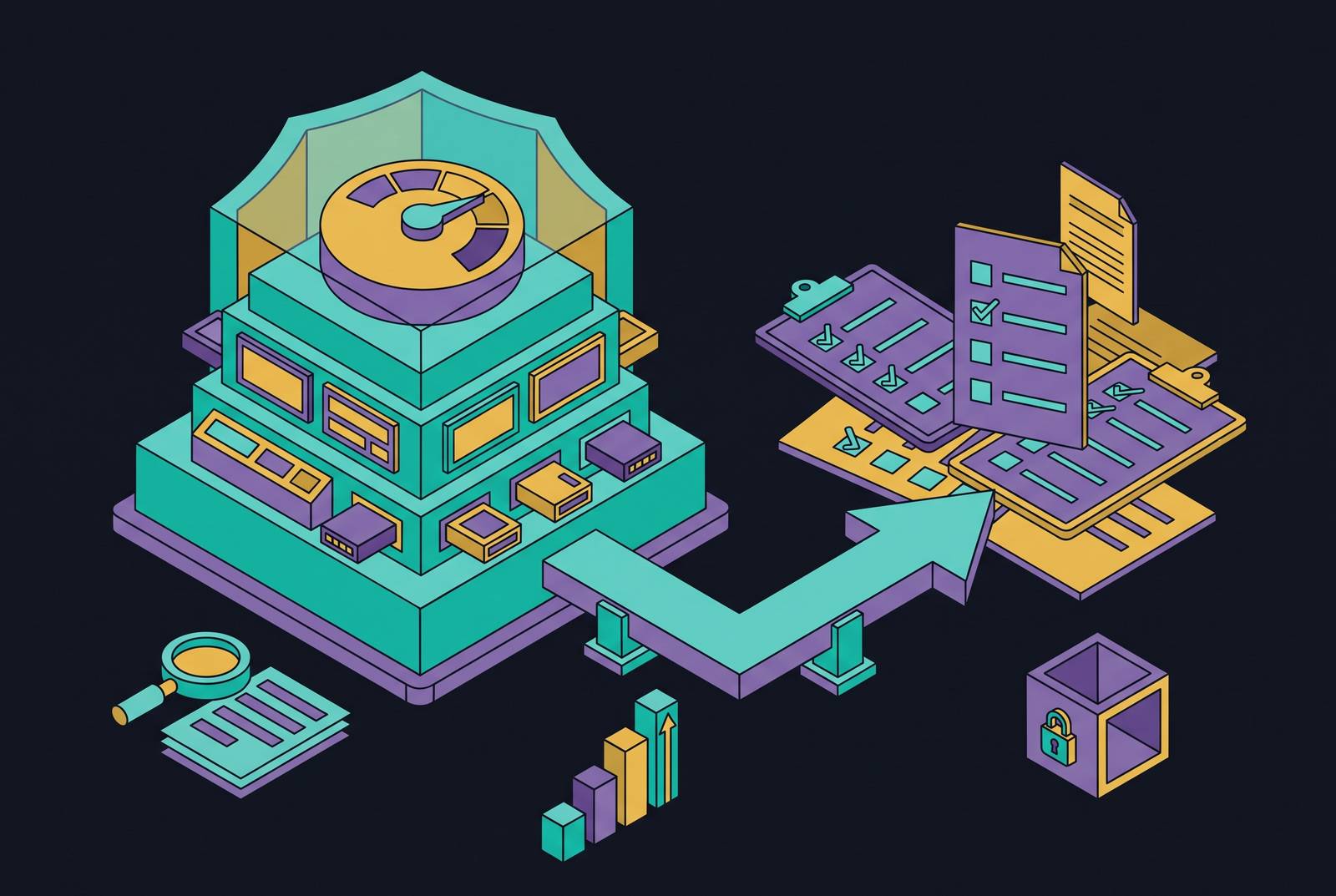
AI vendor risk assessment mapped to OWASP LLM Top 10 and NIST AI RMF requires two connected capabilities, namely technical inspection of LLM threats and governance evidence that supports auditable risk decisions. Purpose-built platforms do more with these capabilities than static checklists can, though no single platform covers both equally. Enterprise vendor scoring needs AI-native tools that link the two layers and keep monitoring after the assessment.
Why the OWASP LLM Top 10 and NIST AI RMF together create a two-layer scoring problem
The OWASP LLM Top 10 names the technical threats that are specific to large language models. It distinguishes risks such as prompt injection, sensitive information disclosure, and supply chain compromise so that an assessment can identify the exposure being evaluated. NIST AI RMF supplies a different structure. Its functions of Govern, Map, Measure, and Manage organize how an enterprise identifies risk, assigns accountability, measures exposure, and documents its response.
What does that distinction mean for vendor scoring? A technical finding establishes what can go wrong, while the governance layer establishes how that finding becomes a documented risk decision. The first layer concerns model behavior, data, tools, and permissions. The second concerns the evidence and responsibility attached to those conditions. An assessment needs both to connect a vendor’s technical exposure to the enterprise’s decision about using its service.
A vendor assessment is incomplete if it passes technical checks but the findings cannot become part of a governance evidence trail. Recorded approvals also cannot show that prompt injection or supply chain compromise has been assessed.
Why the 2025 and 2026 updates to both frameworks made static scoring baselines structurally obsolete
OWASP’s 2025 edition kept only three categories unchanged from 2023, reordered risks based on production incident data, and renamed several entries. It also introduced System Prompt Leakage and Vector and Embedding Weaknesses. The latter responded to community requests for guidance on securing retrieval-augmented generation, or RAG, as it became a core practice. The fixed list of categories from 2023 had no entry for that risk. Scoring against that list would omit a defined exposure.
OWASP’s August 4, 2026 release changed the baseline again. Excessive Agency moved from LLM06 in 2025 to LLM03 in 2026, while Vector and Embedding Weaknesses moved down one place to LLM09 without a scope change. System Prompt Leakage became Hidden Context Exposure at LLM08, with broader coverage extending beyond the literal system prompt to tool schemas, policy logic, and workflow rules. A scoring system must distinguish a change in rank from a change in what an assessment needs to examine.
NIST AI 600-1, the Generative AI Profile released in July 2024, extended the RMF to twelve risk categories unique to or exacerbated by generative AI. It covers confabulation, data privacy, information security, and value chain and component integration. Companion resources grew through 2025 to cover those risks in more depth. Using the base RMF alone therefore misses the substructure directed at generative AI vendor risk. The factual problem with a frozen baseline begins before an assessor answers a question, because the baseline no longer represents the full assessment target.
Why LLM risks are structurally incompatible with one-time attestation
LLMs are probabilistic. A system that resists one prompt injection attempt may fail under different phrasing, because model-side refusal is a probabilistic preference. Passing a test establishes evidence about that test.
Prompt injection also exploits the way LLMs process instructions and content, rather than a discrete defect that can simply be patched away. A document, web page, image, or tool output can become an injection vector. Each new data source or tool integration can thus add to the attack surface. Assessors need to examine what the deployed system reads and how those inputs are controlled.
Sensitive Information Disclosure and Vector and Embedding Weaknesses depend on the contents of the retrieval store and the access controls present when a query runs. An attestation about RAG architecture does not describe what will be ingested next quarter. Supply chain exposure similarly extends beyond the assessed organization, because compromise of a model hub, adapter, or third-party tool can propagate downstream.
Agentic systems add permissions and autonomy to that moving target. A recorded permission scope cannot establish which tools an agent can call in every later session or whether each call is authorized. Deployment updates can alter those conditions. A one-time assessment remains evidence of an earlier state, but it cannot substitute for observing the state in which the vendor’s AI now operates.
Where broad GRC platforms and legacy checklist tools reach their limits on AI vendor scoring
Broad governance, risk, and compliance platforms can route approvals, track tasks, and record sign-offs. The gap appears when workflow records are expected to stand in for AI-specific assessment. Adding questionnaire fields cannot give tools the native AI risk models, maintained AI framework mappings, use-case inventories, or automated compliance scoring they lack.
The resulting failures are organizational as well as technical. Without a shared evaluation process, innovation, data science, legal, and compliance teams can assess the same vendor against different expectations. Static vendor documents then become the common evidence source, even when performance claims cannot be independently verified or replicated. Without a secure, production-like test environment, teams can ask about prompt injection and excessive agency on paper but cannot see how they behave under the relevant conditions.
NIST publishes the AI RMF as voluntary guidance, without a certification body. A statement that a vendor follows the RMF is therefore not, by itself, verifiable evidence of conformity. The vendor needs to produce evidence that maps its controls to the framework’s subcategories. A checklist can ask for that evidence, but it cannot compel its production or validate the technical behavior behind it.
Within this design boundary, the GRC tools an enterprise already has can track who is responsible and who approves, even if they lack the architecture for AI-native inspection. Recognizing that boundary gives the enterprise a more precise procurement question than whether its current platform has an AI questionnaire.
How can one platform assess AI suppliers against both frameworks? The two-layer capability requirement
The requirements should begin with technical inspection and structured governance evidence, rather than a product’s use of the phrase “AI governance.” Both capabilities need explicit evaluation. For the technical layer, the requirement is inspection at the request boundary, covering prompts, attachments, retrieved documents, tool calls, and responses at the relevant point before execution. Policy needs a deterministic classification signal rather than reliance on the model’s probabilistic willingness to refuse.
Documents, tool outputs, memory stores, and retrieval results can introduce indirect injection, while supply chain controls require identity-aware authorization on model calls and endpoint allowlisting. The platform needs to block unauthorized model variants or providers without changes to the application code. Agentic controls must check tool-call sequences and session-level permissions, because calls that look acceptable on their own can lead to unauthorized behavior when combined.
The governance layer needs an inventory organized by vendor and use case, with lifecycle status and risk classification. Maintained mappings must reach the NIST AI RMF subcategories and the GenAI Profile. Evidence capture must be equally specific. Cryptographically signed, per-decision records should contain identity, model version, policy state, classifications, and outcomes so that an auditor can interrogate the decision without manually reconstructing it.
Shadow AI discovery completes this requirements definition by locating vendor AI assets used outside the governed inventory. An unknown deployment creates a gap in both technical oversight and accountability. An enterprise needs these capabilities from the platforms it uses, but some purpose-built products do not yet offer all of them. A general GRC add-on cannot substitute for the distinct inspection and evidence architectures.
How representative purpose-built platforms address the two layers in practice
Cisco AI Defense is a runtime-first, OWASP-aligned option. It provides AI cloud visibility, algorithmic red teaming, network-level runtime guardrails, controls on employee use of third-party AI applications, and model supply chain checks, with alignment to NIST, MITRE ATLAS, and OWASP. Cisco’s February 2026 announcement added an AI bill of materials covering MCP servers, an MCP catalog, adaptive single and multi-turn red teaming, and agentic guardrails. Some announced features were still in development. Its clearest fit is technical inspection, while the available material establishes less depth in NIST subcategory-level governance documentation.
IBM watsonx.governance begins at the governance evidence layer. It provides an AI inventory and governance graph, assistant-led use-case intake, lifecycle risk assessment, shadow AI detection, policy and obligation mapping, and automatic evidence capture. Its mappings include the EU AI Act, NIST AI RMF, and ISO/IEC 42001. Infosys is one enterprise that uses the platform across a large number of AI use cases. The distinction for procurement is where enforcement happens.
The governance platform does not sit in the request path to broker or block AI traffic. Its enforcement operates through lifecycle workflows, evaluations, and threshold alerts, while runtime blocking depends on separate products, including watsonx.ai guardrails and watsonx Orchestrate. Inline OWASP threat blocking also requires additional Guardium capability.
Check Point AI Guardrails, formerly Lakera Guard, addresses runtime protection of LLM inputs and outputs. The product uses technology from Lakera, whose acquisition Check Point announced in September 2025, to protect against injection, data exposure, and unsafe content. It belongs on the technical shortlist. The available material does not establish comparable depth in governance documentation or NIST RMF mapping.
Holistic AI focuses on compliance assessment and audit artifacts. It offers framework assessments for the EU AI Act, NYC LL 144, ISO 42001, and NIST AI RMF, classifies systems, runs risk and impact assessments, and generates model cards, conformity reports, and audit artifacts. Runtime technical inspection is not a stated capability in the available material.
The shortlist therefore divides by function. Cisco and Check Point emphasize technical protection, while another governance vendor and Holistic AI emphasize governance and evidence. Products can be hard to link when runtime enforcement, gateway inspection, and governance records do not share a data model. That objection deserves weight, but general tools do not remove it while supplying the missing AI capabilities. The practical choice is purpose-built tooling with integration work or general tooling with unresolved capability gaps.
How continuous vendor monitoring closes the gap that even strong purpose-built platforms leave open at assessment time
A sophisticated assessment still becomes stale if it remains an event. Between reviews, vendors update model versions, add tools, and expand what their agentic capabilities can do. Each change can introduce supply chain or excessive agency exposure that the original assessment did not cover. Meanwhile, changes to OWASP categories and NIST companion guidance can make an otherwise unchanged deployment subject to a different assessment baseline.
Continuous monitoring must therefore follow vendor AI assets across their lifecycle, including model updates and new tools or plugins. It also needs automated alerts when a deployment introduces a new risk category. A newly added tool can create Excessive Agency exposure, while a new data source can create Vector and Embedding Weaknesses. The mapping between observed behavior and OWASP categories must stay current throughout the internal review cycle.
Those technical observations must stay linked to governance evidence. Otherwise, an enterprise can detect a changed deployment while leaving its vendor score and documented risk decision anchored to the old state. TPRM, InfoSec, Privacy, and Legal teams need to link vendor assessment to real-time AI threat detection across the vendor ecosystem. The aim is to surface emerging threats before they undermine compliance or business continuity.