GitHub Copilot Enterprise Attack Surface Assessment
Massive scale and unrestricted agent access create blind spots existing security tools can't see.
GitHub Copilot Enterprise now sits inside roughly 90% of Fortune 100 companies, with around 20 million total users by July 2025 and 4.7 million paid subscribers by January 2026, up 75% year over year. That scale makes Copilot a load-bearing piece of the software supply chain. It's a load-bearing piece of the software supply chain, and it carries an attack surface that plain code scanners were never built to see.
Industry surveys have found 84% of professional developers using or planning to use AI coding tools, even as concerns about those tools' accuracy have persisted. A 2024 GitHub survey put enterprise adoption at 97%, some of it running through personal accounts against corporate repositories with no organizational sign-off. Meanwhile the output keeps piling up: 46% of code accepted by Copilot users is AI-generated, and a Q4 2025 study of over 135,000 developers found 22% of merged code was AI-authored. That's a lot of machine-written code sitting in production, and none of it looks like anything SAST, DAST, or SCA tools were designed to catch. Those tools assess artifacts and known vulnerability signatures. They have no way to look at a prompt channel, an AI config file, or an agent session and ask whether something went wrong there.
How Copilot Enterprise's architecture creates the attack surface
Copilot's basic move is simple: take the file a developer is working in, the surrounding code, and whatever prompt gets typed, then ship all of it to a hosted model. Checkmarx (2026) found that handoff, the model boundary, is where a lot of the risk concentrates, because sensitive data sitting in a prompt or in nearby code can shape what the model spits back out.
The model is predicting likely code based on patterns it learned during training. It's predicting likely code based on patterns it learned during training. Filters and guardrails sit around that prediction engine, but they don't remove the underlying tendency to generate something insecure if that's what the training data made statistically probable.
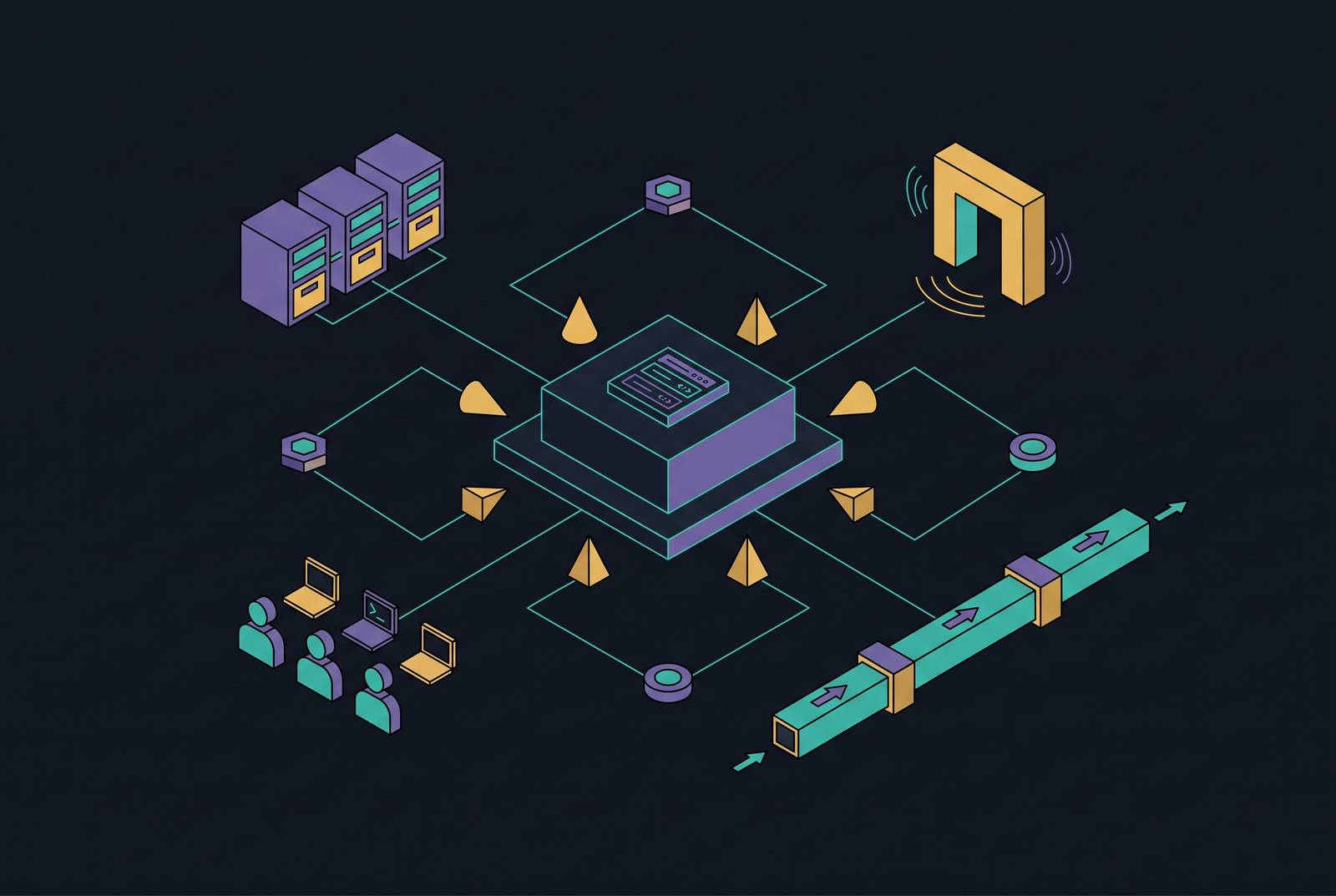
Three layers stack on top of each other here, and each one adds room for something to go wrong.
The input layer covers everything Copilot reads: files, comments, issues, pull request descriptions, web content, and outputs from MCP tools. All of it gets treated as context the model can trust, not as input that might be hostile. The agent layer is where things get sharper. In agentic mode, Copilot gains capabilities well beyond plain read-only assistant mode, including the ability to interact with external tools and perform actions across the developer environment. Then there's the output layer: developers consume what Copilot writes, and there's a real tendency to treat AI suggestions as more authoritative than they'd treat, say, a pull request from an unknown contributor.
Put those together and a specific problem appears: untrusted GitHub data, things like issue text or PR descriptions, flows into an agent that might also be holding production secrets and unrestricted tool access, all in the same runtime. Nothing enforces separation between what the agent reads and what it's allowed to act on.
Enterprise tier makes this bigger, not smaller. Organizational knowledge bases, fine-tuned models, and deeper GitHub integration all expand what the model ingests, and by extension, what an attacker has to work with. On data handling, GitHub says Copilot Business and Enterprise don't feed customer code back into model training. But other entry points, GitHub.com, mobile clients, personal accounts, operate under different data handling terms that most security teams aren't accounting for. That's a retention window most security teams aren't accounting for.
The input layer, the agent layer, the token flow between them, and the output that developers end up trusting each map to one of the four attack classes that follow.
Prompt injection as an attack class: how untrusted content hijacks the agent
Prompt injection doesn't need stolen credentials or a malware payload. It compromises the agent through the exact content the agent is built to process. One sentence embedded in a document, a code comment, or a GitHub issue can redirect what the agent does next.
Four disclosed vectors show how this actually plays out.
RoguePilot, disclosed by Orca Security in February 2026, starts with a malicious GitHub issue. Launch a Codespace from that issue, and passive prompt injection fires: Copilot silently executes instructions the attacker planted in the issue text. The full chain runs from issue text, into the in-environment Copilot agent, ending in exfiltration of a privileged Codespaces GITHUB_TOKEN and a full repository takeover. GitHub patched it after Orca's disclosure.
Hidden Markdown injection works differently but hits a more common surface: pull requests. Researchers demonstrated that PR descriptions can be crafted to influence Copilot Chat, turning a routine code-review feature into a delivery mechanism.
Comment and Control weaponizes PR titles, issue bodies, and issue comments across multiple AI coding agents, not just Copilot. An attacker writes a malicious PR title or issue comment, the agent reads it as trusted context, executes what's buried inside, and exfiltrates credentials back out through a PR comment, an issue comment, or a git commit. No external server needed, the whole loop stays inside GitHub. GitHub initially called the report a "known issue" before awarding a $500 bounty. Confirmed vulnerable agents included GitHub Copilot Agent (SWE Agent), Anthropic's Claude Code Security Review, and Google's Gemini CLI Action.
And in August 2025, Trail of Bits described an attack where a filed issue, if a maintainer assigns it to Copilot, tricks the agent into inserting a backdoor into the project. Trail of Bits' own assessment: this category grows as agent adoption grows, not shrinks.
All four share the same root cause. Untrusted GitHub content and an agent with production access sit in the same runtime, and the platform doesn't separate them. Any real assessment of Copilot has to enumerate every channel the agent reads from, issues, PR descriptions, web pages, MCP tool outputs, not just the code sitting in the repository.
Agentic code execution: how "YOLO mode" and MCP expand the blast radius
CVE-2025-53773 is a critical-severity vulnerability that got patched in the August 2025 Patch Tuesday cycle. It's a critical remote code execution bug in Copilot and Visual Studio Code, and it comes from Copilot's ability to modify project configuration files, specifically .vscode/settings.json, without asking the user first. Changes hit disk immediately. No reviewable diff, no prompt to approve.
A malicious prompt sits inside source code, a web page, a GitHub issue, or some other ingested content. Copilot modifies settings.json to add "chat.tools.global.autoApprove": true. That flips on what's been nicknamed "YOLO mode," turning off every user confirmation step. From there the agent runs shell commands, browses the web, and performs privileged operations across Windows, macOS, and Linux with nobody checking in.
What that unlocks, demonstrated in practice: joining compromised developer machines to botnets researchers called "ZombAIs," and building self-propagating AI viruses that hide malicious instructions in Git repositories, spreading further every time a developer pulls the infected code and interacts with it. The same flaw let attackers modify .vscode/tasks.json and quietly add malicious MCP servers.
Microsoft's fix landed in Visual Studio 2022 version 17.14.12: AI agents can no longer touch security-relevant configuration files without explicit user approval. Disclosed August 12, 2025, with Microsoft noting it was already tracking the issue internally before that.
That MCP detail matters beyond this one CVE. Model Context Protocol extends what tools the agent can reach into external systems, so the blast radius of any successful injection scales directly with how many MCP integrations an enterprise has wired up. More integrations, more surface, plain as that.
Two more disclosures followed on November 11, 2025, both rated "Important": CVE-2025-62449, a path-traversal flaw (CWE-22) in the VS Code Copilot Chat Extension, and CVE-2025-62453, affecting both Copilot and VS Code, tied to improper validation of generative AI output.
Assessing this properly means going past what Copilot reads and inventorying what it can write and execute: every tool permission, every MCP integration, every auto-approval flag across the developer environment. At least 35 CVEs disclosed in March 2026 alone traced directly back to AI-generated code. That's not a fluke month. That's a pattern.
Token and secret exfiltration: the data loss vector hiding inside the AI workflow
GitGuardian's State of Secrets Sprawl 2026 found that repositories using Copilot leak secrets at a 6.4% rate, against 4.6% across all public repositories, a 40% higher incidence rate. Total leaked secrets on GitHub hit about 29 million, up 34% year over year.
Three separate mechanisms drive this, and they are distinct problems rather than one blob.
Active injection is the sharpest of the three. CVE-2025-59145, nicknamed "CamoLeak," carried a 9.6 CVSS score and got quietly patched before its public disclosure in October 2025. It let attackers pull API keys and private source code out without running any malicious code. The trick: bypassing GitHub's Content Security Policy by routing through Camo, GitHub's own trusted image proxy, so the traffic looked completely legitimate. Omer Mayraz of Legit Security described it as combining "a novel CSP bypass using GitHub's own infrastructure with remote prompt injection." GitHub's fix was blunt: disable image rendering in Copilot Chat. That's a telling remediation. It shows how little a content security policy can do once an attacker finds a way through infrastructure the platform already trusts.
RoguePilot, covered above for its agent hijack, doubles as a token exfiltration story: the JSON $schema mechanism pulls the GITHUB_TOKEN out without user approval, and that token carries read and write access to the repository.
The third mechanism is quieter and harder to fix. Security researchers have raised concerns that models trained on public repositories may memorize sensitive material, and that downstream exposure risks could persist regardless of what happens to the original source. Once a secret is baked into training data, deleting it from the original repository may not undo the exposure. It's already learned, and that changes what deletion can accomplish.
Shadow AI widens all of this. Shadow AI adoption includes personal accounts running against corporate repositories, operating outside the data handling controls that enterprise tiers provide. Secret scanning on repository content catches part of the picture. It says nothing about prompt channels, chat interfaces, MCP outputs, or the accounts operating entirely outside the org's visibility.
Insecure code generation: the vulnerability that ships in the product
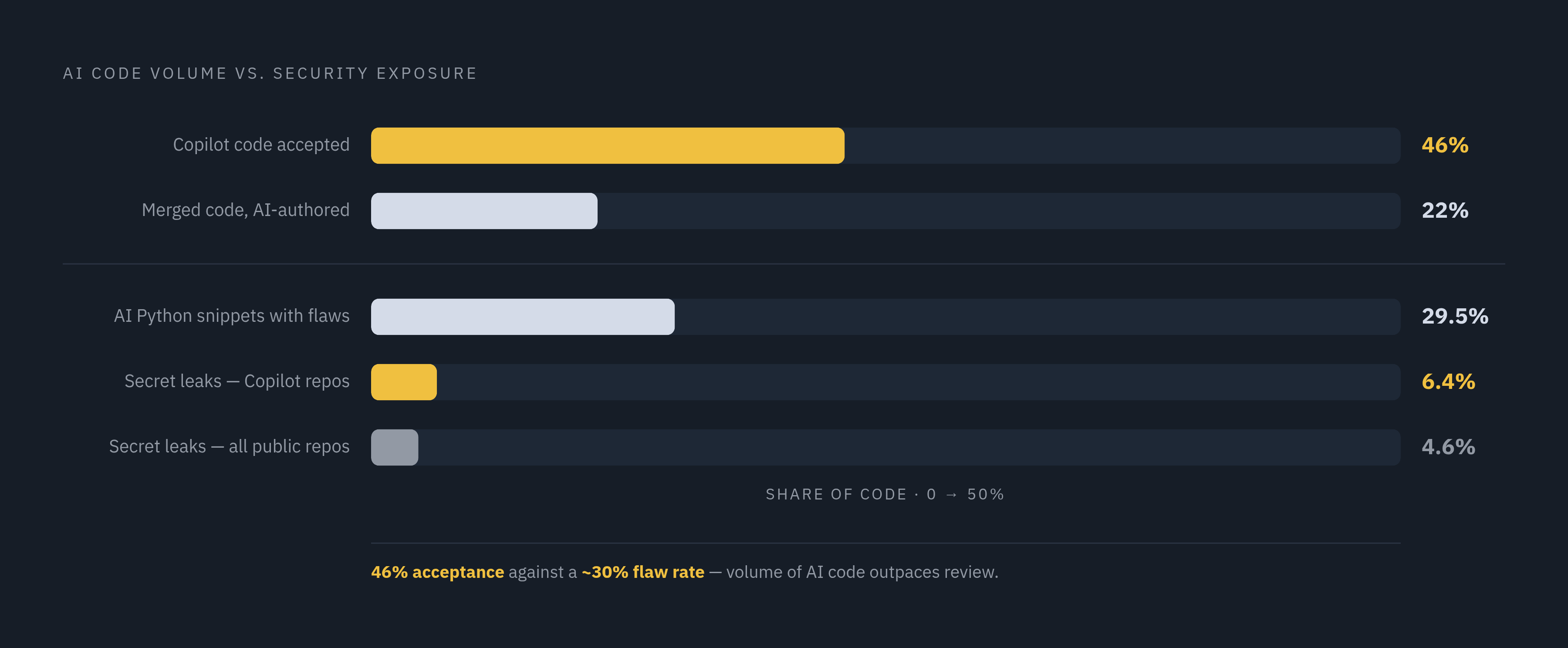
A study published in ACM TOSEM looked at 733 AI-generated code snippets across Copilot, CodeWhisperer, and Codeium. Result: 29.5% of the Python snippets and 24.2% of the JavaScript snippets carried security weaknesses. A separate figure put AI-generated Python code with flaws like SQL injection and cross-site scripting at 29.1%.
None of that is a bug waiting to be patched. It's how the model works. The model predicts likely code from patterns it absorbed during training, much of it pulled from public repositories where insecure code is common. It has no built-in sense of what's safe. Just what's statistically probable given the context it's fed.
Pillar Security's Rules File Backdoor research shows how this compounds into a supply chain problem. Attackers hide malicious instructions inside .cursor/rules files or equivalent Copilot config files, using zero-width joiners, bidirectional text markers, and other invisible Unicode tricks that human reviewers can't spot in the IDE or in GitHub's PR approval view. Once a poisoned rule file lands in a repository, it shapes every future code-generation session in that project, and it tends to survive forking, spreading the exposure downstream to projects nobody involved in the original compromise ever touched. Pillar traced the spread through developer forums sharing "helpful" rule files, open-source pull requests, and project starter templates.
GitHub's initial response put the burden on users to catch this themselves. By May 1, 2025, GitHub added a warning for hidden Unicode text on github.com, a partial fix that leaves other distribution channels these files travel through unaddressed. CVE-2025-62222 later documented similar flaws in Copilot through crafted repository content, echoing issues found earlier in Cursor.
Copilot is built as an assistive tool, on the premise that developers will check its output before it ships, and that assumption is straining under its own weight. But acceptance rates are 46%, even as concerns about AI accuracy have persisted. That's a widening gap between how much code gets waved through and how much confidence developers actually have in it. The oversight layer the whole design depends on isn't holding at the level the design assumes.
Assessing this properly means checking the integrity of rule files and configuration inputs, confirming SAST and DAST coverage actually reaches AI-generated code paths specifically, and asking whether code review treats AI output with the same skepticism it would apply to a pull request from a stranger.
What Microsoft's built-in controls cover and where they stop
The platform's native protections address a real slice of this problem: filtering around the model, patches issued for specific disclosed CVEs, retention policies for Business and Enterprise tiers that keep customer code out of training data, and a warning system for hidden Unicode text on github.com.
But look at where each fix landed. CamoLeak's remediation was disabling image rendering, not building a durable defense against CSP bypasses through trusted infrastructure. The Unicode warning is a partial fix that doesn't reach every distribution channel these files travel through. RoguePilot and CVE-2025-53773 both got patched after disclosure, reactive fixes to specific chains rather than a structural answer: untrusted content and privileged agent access share one runtime with no enforced boundary.
An enterprise running Copilot at scale still has to build its own layer on top: tighter MCP permission review, secret scanning that reaches further, and more. Each fix closes one door. None of them redesigns the house. An enterprise running Copilot at scale still has to build its own layer on top: tighter MCP permission review, secret scanning that reaches prompt and chat channels and not just repository content, config file integrity checks, and code review standards that treat AI-generated code with the same suspicion applied to an unfamiliar contributor's pull request. Microsoft's controls handle what Microsoft can see from inside the product. Everything the enterprise configures around one AI coding assistant, the MCP servers, the auto-approval settings, the shadow AI accounts operating outside official sanction, stays the enterprise's problem to solve.
Sources
- GitHub Copilot Security Risks: 5 Issues + Fixes (2026) - Checkmarx
- GitHub Copilot RCE Vulnerability via Prompt Injection Leads to Full System Compromise
- New Vulnerability in GitHub Copilot and Cursor: How Hackers Can Weaponize Code Agents
- GitHub Issues Abused in Copilot Attack Leading to Repository Takeover
- Hackers Exploit GitHub Copilot Vulnerability to Exfiltrate Sensitive Data
- GitHub Copilot and Visual Studio Vulnerabilities Allow Attackers to Bypass Security Features
- GitHub copilot security risks: what enterprises need to know | MintMCP Blog
- labs.cloudsecurityalliance.org