Scoring Vendor LLM Deployments for Incremental Context Extraction Detection Before Breach Confirmation
Detecting incremental prompt extraction across vendor LLM sessions before breach confirmation.
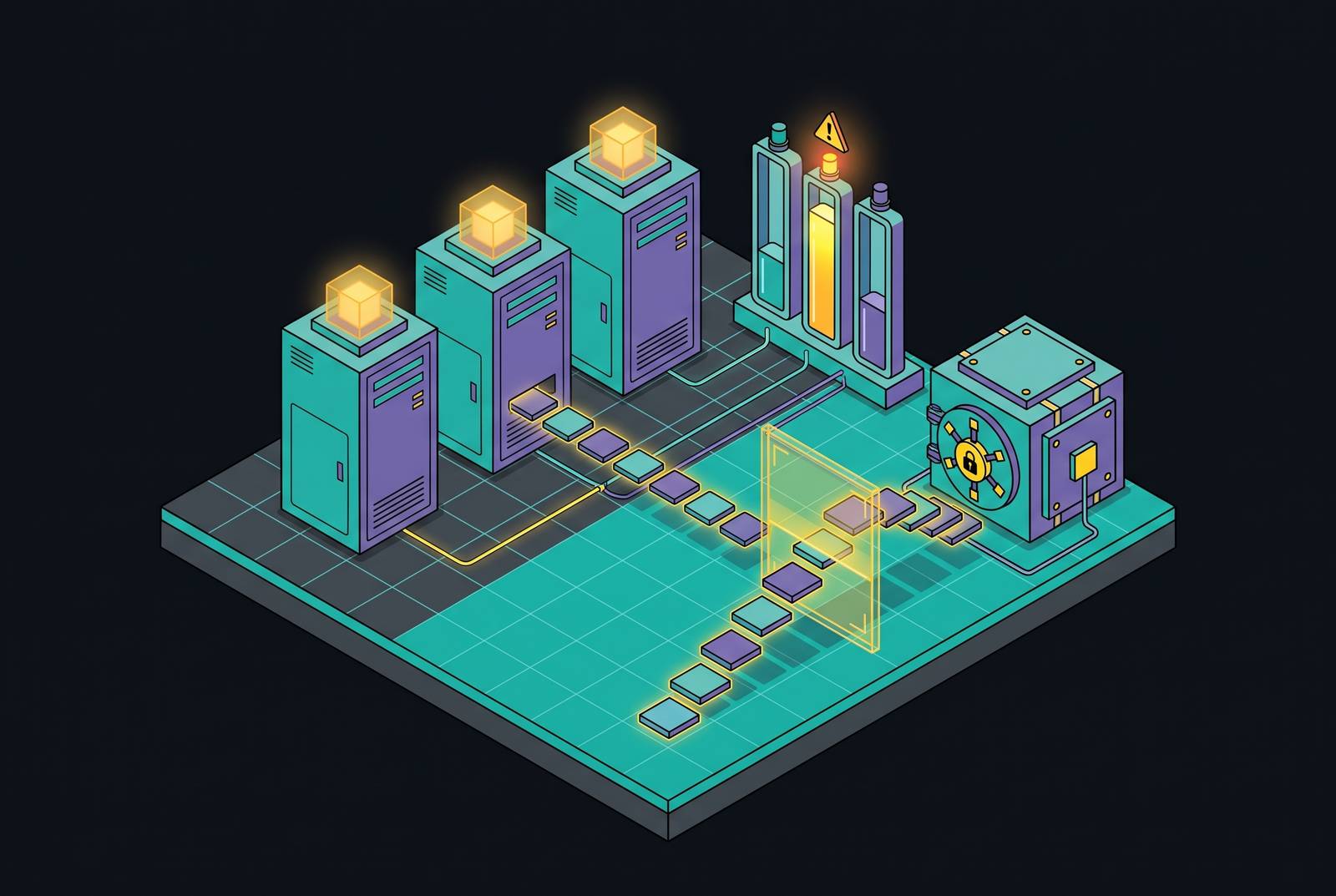
System prompt confidentiality and data exfiltration risk detection in vendor LLM deployments require layered monitoring before a breach is confirmed. Pre-decoding leakage signals, within-session trends, and cross-session capability tracking show risks that checks of a prompt on its own miss. A vendor assessment should score those detection layers separately from enforcement, tool controls, and audit evidence, then reassess them as the deployment changes.
Why incremental context extraction is structurally different from single-turn attacks
A request can look harmless while advancing a harmful conversation. Incremental context extraction takes advantage of that gap by spreading malicious intent across turns, each nudging the model toward forbidden output. Microsoft researchers introduced the Crescendo pattern in 2024, showing how conversations that begin benignly can escalate, typically in fewer than 5 turns. The weakness is the assumption that judging each turn independently is enough to judge the interaction.
Context extraction targets information already available to the model, including proprietary system prompts and private information embedded in them. An attack can induce the model to repeat that context when it encounters a special trigger. The KDD’25 model extraction survey classifies prompt-targeted attacks separately from functionality and training-data extraction. That distinction identifies what the attacker wants to recover.
The boundary can extend beyond the entry-point agent. MASLEAK shows how a single crafted query can hijack execution in a black-box multi-agent deployment, propagate through its topology, and extract prompts, task instructions, tool specifications, agent count, and system architecture. Although its entry mechanism differs from Crescendo, it exposes the same weakness in treating one visible exchange as the whole event. Recovered prompts can reveal refusal heuristics, safety exceptions, and tool configurations that support targeted jailbreaks or tool misuse.
Why extraction campaigns operate at cloud scale and across sessions
Sophisticated extraction campaigns treat cloud-hosted LLM providers as a shared attack surface, working across providers and splitting their goals among sessions that run on their own. One session might ask for tool definitions, while another asks for email-sending code. Neither need contain the complete forbidden objective. The adversary can assemble the pieces outside the model, leaving a session-bound detector without the context needed to recognize the campaign.
What happens when the vendor upgrades its model? A 2026 paper on cross-session decomposition attacks found that recovery from dispersed support can strengthen with model capability. A more capable model is therefore not automatically a safer one under this threat model. The cross-session and cross-provider dimensions make extraction both an application security problem and a vendor risk problem. An organization integrating a third-party API inherits exposure shaped by systems beyond its own application.
That exposure also leaves a way in for indirect prompt injection through emails, documents, web pages, and RAG-retrieved records. Washington University in St. Louis’s context-aware detection research notes that autonomous agentic systems may keep running in compromised states for a long time before anyone detects them. Research published at COLM 2026 also shows that semantically equivalent query variations can induce responses unfaithful to retrieved context across open-source and closed-source models. Query manipulation can affect both what a model reveals and what it fabricates, although those remain distinct failure modes.
How current vendor risk scoring instruments fail to see session-level behavior
Outside-in domain grading measures DNS health, IP reputation, and patching cadence. Those infrastructure signals leave model behavior under multi-turn pressure unmeasured. Purpose-built AI governance questionnaires address different questions, including vendor criticality, privacy, incident management, and training on customer data. Yet those templates do not specify session-trajectory monitoring as a required control. Their coverage can be useful without answering whether a deployment recognizes incremental probing.
Single-query anomaly scoring gets closer to the interaction but still scores one query at a time. Individual extraction requests often look like benign requests, so a campaign may move forward without a clear per-turn signal. OWASP Top 10 for LLM Applications 2026 names Hidden Context Exposure, formerly System Prompt Leakage, as LLM08, separately from Prompt Injection and Sensitive Information Disclosure. But naming that risk does not provide the telemetry needed to see how it grows.
The intuitive weighted-average approach converges to the per-turn score regardless of turn count, allowing a 20-turn persistent attack to score identically to a single suspicious turn. A score labeled “session risk” can therefore remain effectively turn-bound.
For vendor due diligence, this gap is especially consequential in Tier 1 deployments. These are customer-facing AI systems that process regulated data, including PII, PHI, and financial records, and make or inform consequential decisions. A full assessment of these systems includes delivery of an AIBOM, mapping of fourth-party sub-processors, and dedicated AI incident response SLAs. Behavioral evidence must complement that documentation because governance records alone do not show how a model responds to an extraction trajectory.
Three scoring primitives that capture pre-breach session signals
LeakGauge addresses the earliest layer, before output is decoded. It appends a suffix that gauges leakage behavior and maps prefill token probabilities to an attack-risk score. Its content-agnostic gauge verbalizes leakage behavior rather than probing for specific confidential content, producing more robust signals when content changes language or disclosure shifts from verbatim to semantic. Across 11 LLMs, including dense and MoE architectures, it achieved an AUROC of 0.944–0.996 on unseen attacks. The method requires only a handful of extra parameters and adds minimal latency, but its pre-decoding signal is not a substitute for tracking a conversation.
Peak + accumulation session scoring tracks how that conversation changes. It combines peak single-turn risk, persistence ratio, and category diversity, drawing on CUSUM change-point detection and Bayesian belief updating. The useful distinction is the direction of change. In the evaluation, attack sessions climbed across turns while benign sessions stayed flat just below the single-turn firing line. A combined trend rule detected all attacks in a test set at a low benign false-flag rate, with a mean fire turn well before attack completion. That result supports early intervention in the tested setting.
An entity-level capability framework looks beyond one conversation at a time. It tracks demonstrated capability rather than stated intent and aggregates evidence at the entity, or user ID, level. This addresses decomposition that a within-session trend detector cannot see when each conversation looks benign. The three layers therefore answer different questions. LeakGauge probes leakage behavior before decoding, session scoring detects progression, and the entity-level framework examines capability assembled over time.
Context-aware detection, or CAD, deals with the related risk of indirect prompt injection. The Washington University team combines sentence embeddings with query and context information, measuring a sentence’s marginal impact on those representations. Two adversarial training variants harden the method against adaptive paraphrasing. CAD outperformed the evaluated defense baselines under static and adaptive paraphrasing attacks while preserving high utility. It complements the three core primitives when retrieved documents or other external text enter the context window.
What adaptive attackers do when scoring thresholds are known—and what that means for framework design
Can an attacker simply learn the scoring rules? That is the strongest objection to relying on them. An adaptive adversary can tune requests against a published threshold structure, so neither strong test results nor a session-level label establishes lasting protection. The KDD’25 survey identifies adaptive defenses that balance security with model utility as an open research direction. Static defenses are not a settled answer to an adaptive threat.
The practical aim is cost asymmetry. Session-level scoring can increase the time and effort extraction requires, creating opportunities for detection before the objective is complete. That is useful even when a capable adversary retains a path forward. But it depends on how the scoring is built, because a poorly chosen aggregation rule may give confidence without making the attacker’s job harder. None of the three primitives removes that limitation by itself.
The lesson for framework design is to treat thresholds as parameters requiring continuous calibration. Reassessment should be mandatory at contract renewal, after a vendor model change, and after a reported security or AI-safety incident. Capability increases warrant closer scrutiny. The framework can then quantify exposure under current conditions while making explicit when its evidence has become stale.
A four-surface, seven-dimension scoring rubric for vendor LLM deployments
A useful rubric separates where exposure occurs from how the vendor detects and controls it. Its four surfaces are input, output, retrieval, and tool-call. Input covers users typing secrets into prompts, while output covers the model regurgitating context or echoing prior PII. Retrieval covers RAG pulling cross-tenant or PII-laden context, and tool-call covers an agent passing scoped data into a tool. These surfaces need separate metrics because a single total can conceal the location of a weakness.
Seven dimensions provide the other axis of assessment. Threat coverage asks whether detection works on each surface. Protocol decoding asks whether it recognizes injection embedded in structured formats, including JSON, XML, and retrieved documents. Interaction-level context asks whether monitoring follows whole sessions. These dimensions distinguish breadth of coverage from the depth of context a detector actually uses.
The next dimensions test what happens after detection. Inline enforcement asks whether the system acts when a session-level signal fires or just logs it. Agent-to-tool execution control asks whether calls are scoped and auditable, addressing cross-agent leakage of the kind MASLEAK demonstrated. Audit evidence asks whether the vendor can provide session-level logs to use in post-incident forensics and regulatory reporting. Deployment model asks whether the architecture supports tenant isolation or leaves paths for cross-tenant extraction because of assumptions about shared infrastructure.
For TPRM, InfoSec, Privacy, and Legal teams, the result is a diagnostic profile. Strong detection cannot make up for weak inline action or weak agent control, so those controls each need their own gate criteria. Existing academic Risk Severity Index frameworks compare security posture across harm topics and can be adapted to serve as a basis for context-extraction scenarios. The rubric does not claim to be exhaustive or to prevent extraction. Its purpose is to quantify risk before breach confirmation, with a full reassessment at contract renewal, after a vendor acquisition, after a material model change, and after a reported security or AI-safety incident.
How continuous vendor AI monitoring closes the gap that point-in-time assessment leaves open
A vendor assessment describes a deployment at a particular time. Model updates, new plugins, retrieval connectors, and expanded agent capabilities can reopen surfaces that were previously scored. MASLEAK achieved an average attack success rate of 87% for system prompts and task instructions across evaluated multi-agent applications, including Coze and CrewAI. Its average success rate for system architecture extraction was 92%. Those results show why an assessment must account for the connected deployment.
A changed model can alter refusal heuristics or safety exceptions, while a new retrieval connector changes what reaches the context window. Such changes can occur without formal notification to the enterprise customer. Interaction-level context and agent-to-tool execution control need to be checked again when the deployment changes. Monitoring must track how capability builds up across sessions and contract periods.
Traditional vendor risk teams often do not have the API behavioral telemetry they need to use these methods. Generic SaaS and infrastructure governance frameworks do not expose session trends or entity-level capability accumulation. A platform that brings together vendor risk assessment and real-time AI threat detection across the vendor ecosystem can fill this monitoring gap by linking structured assessment to ongoing checks of behavior. The capability is valuable only insofar as it supplies evidence that a point-in-time questionnaire cannot.
The operational requirement is to connect change with reassessment. Organizations should establish monitoring triggers for vendor model changes, new agent integrations, and reported incidents, using those events to revisit the affected rubric dimensions. They should also require session-level audit evidence as a contractual deliverable alongside attestations. That leaves teams with both a reason to reopen the assessment and the evidence needed to judge what changed.
Sources
- Robust Context-Aware Detection of Malicious Instructions in Text
- A Survey on Model Extraction Attacks and Defenses for ...
- IP Leakage Attacks Targeting LLM-Based Multi-Agent Systems
- The Model's Tell: Measuring Context-Leakage Attack Signals with Behavior Gauges
- Eliciting Intrinsic Hallucinations in LLMs via Semantically Equivalent Adversarial Attacks