Glean Enterprise AI Search Security Posture Review
Glean's access controls inherit your company's permission mess and can expose too much at once.
Glean's security model is built on a simple bet: if you connect an AI search layer to every app in the company, that layer has to enforce the same access rules those apps already have, or it becomes the single easiest place to see things you're not supposed to see. This piece walks through where Glean's native controls actually hold up, where the architecture creates open questions, and what a compliance team still has to check for itself before and after rollout.
Glean started in September 2021 as a way to search across a company's scattered tools. By early 2025 it had reached significant ARR milestones, and in August 2026 it announced a $768 million growth-stage financing round to accelerate its expansion. That kind of growth changes what Glean is, in a practical sense. Glean's own product page states that a tool that used to just search Gmail, Salesforce, Slack, Jira, GitHub, Confluence, SharePoint, and Google Drive now connects to over 275 work apps. At that scale, security stops being a footnote in a vendor questionnaire. It becomes the first thing TPRM, InfoSec, Privacy, and Legal teams need to nail down, whether they're doing a pre-deployment review or watching the system after go-live.
The promise is straightforward enough: one search layer that respects the permissions already in place across every connected system, and lets teams build agents on top of what it finds. But that promise only holds if the enforcement is airtight. An AI system that can see across every app at query time either draws the same lines the source systems draw, or it turns into the widest unlocked window in the building. Which one it is depends on details most procurement conversations skip past.
Glean's data ingestion, storage, and the architecture debate over compliance scope
Glean runs connectors inside each customer's own dedicated cloud project. Data moves over HTTPS, and connections into internal systems use secured network paths. Storage is designed to stay inside the customer's tenant environment. The infrastructure is single-tenant: one customer's index doesn't mix with another's, and per Glean's documentation, customers can run this on AWS, Azure, or GCP, either Glean-hosted or hosted within their own cloud.
That hosting choice actually matters for scope. With Glean Hosted, a true SaaS setup on GCP, Glean owns the infrastructure and the responsibility that comes with it. With Customer Hosted (what used to be called Cloud-Prem), Glean runs as a managed service inside the customer's own cloud account, and the customer keeps control of the environment around it. Two very different answers to "who's responsible for this" depending on which box gets checked.
Then there's the part of the story that isn't settled. One account describes Glean's indexing as minimal-footprint: content stays at the source, and only vectors and metadata are cached temporarily, which keeps data sprawl and attack surface down. A competing account from GoSearch tells a different story: Glean indexes and stores a centralized copy of enterprise data, which for a regulated company means sensitive PII gets duplicated into a second index, widening audit scope and compliance exposure.
Both of these get used in real sales conversations, and the disagreement seems to hinge on what "indexing" even means. Vectors and metadata are not the same thing as a full document copy, but from the outside, a customer can't always tell which one they're getting. So which is it? That's not a question this piece can settle from the outside, and it shouldn't be treated as settled by either side's marketing page. Companies in regulated industries need to ask Glean directly: what gets stored, where does it live, and how long does it stay there. The answer changes whether Glean's index falls inside a DPA's audit scope, and whether a data subject access request needs to account for anything Glean is holding on to.
Swanum's July 2026 review noted that Fireworks.ai, Inc. was added as a new Glean sub-processor. That's a new third party now potentially touching customer data. Anyone with an existing DPA should check that name against their approved sub-processor list and confirm their notification rights actually got triggered.
Glean's permission model, its enforcement, its currency, and where gaps can open
Glean's stated design is least-privilege, applied consistently across search, the Assistant, and Agents. A user should only ever see what they were already allowed to see in the source system. Glean isn't supposed to add access, only mirror it.
When someone loses access somewhere upstream, Glean runs a delta-sync to pull that access in near real time. That matters most in offboarding, or when someone rolls off a project and shouldn't see that project's files anymore. Glean's stated design calls for permission checks to occur before content is surfaced to the user, so the model only receives context the user was already authorized to see.
So where does this break down? Every connected source handles permissions its own way; some use flat user lists, some use nested groups, some use role-based structures with quirks unique to that platform. Glean has to reverse-engineer each one to map it correctly, and a connector that misreads a source's permission logic will either lock out people who should have access or expose things that should have stayed hidden. Not every connector in the 275-plus lineup has the same depth of permission fidelity, either, so a company's actual risk depends heavily on which specific tools are wired in, not on the platform's headline count.
A deeper problem causes all of this, and it has nothing to do with Glean directly. Most SaaS environments, Google Workspace especially, walk into a Glean deployment already carrying years of misconfigured sharing settings and permissions nobody ever cleaned up. Glean doesn't fix that. It inherits whatever mess is already there, and then it makes that mess searchable. A clean Glean rollout on top of a dirty permission baseline is still a dirty permission baseline, just with better discoverability. Fixing source-system permissions before deployment is the actual prerequisite. It's the actual prerequisite.
The oversharing risk: where correct permissions still produce wrong outcomes
Oversharing, in this context, means something specific: permissions were technically fine, and the AI still combined things in a way that shouldn't have happened.
Picture a junior employee who has legitimate, technical access to internal planning documents, maybe because of how a shared drive was set up two years ago. They ask a routine product question. The AI pulls together roadmap details and operational context the employee is authorized to read but was never actually meant to see all at once, in that combination, with that framing. Permission was satisfied. Permission was satisfied, but need-to-know was not. Permission was satisfied, but need-to-know was not, and that mismatch is the gap.
Why is this hard to fix structurally? Access control in most systems is binary: view or no view. There's no setting for "you can see this document alone, but not this document plus that other document plus this third one." AI assistants live in relational territory, though, stitching together pieces that were each individually fine and producing something that, taken as a whole, was never meant to exist in one place.
It helps to separate two things that get conflated. Zero-copy or minimal-indexing design cuts down data sprawl, resulting in fewer physical copies of a document floating around. Access sprawl is a different animal entirely: it's the accumulation of broad entitlements that let too many people see too much, and no amount of clever indexing architecture touches that problem. One is about where data lives. The other is about who's allowed to look at it, and how many people that turns out to be once you actually count.
Without ongoing monitoring and cleanup of SaaS permissions, Glean can speed up exposure of information that would have otherwise sat quietly, unfound, buried under bad folder structures and stale group memberships. Bad permissions used to be a slow leak. An AI search layer turns them into a faucet. Generic governance checklists tend to miss this gap, and continuous, dedicated monitoring of AI-connected data exposure earns its keep here, run not as a one-time pre-deployment check but on an ongoing basis.
Glean Protect and its agent governance controls: what the platform offers natively
Glean Protect is the governance layer sitting on top of all this, and as of August 2026, Glean Protect+ documentation on docs.glean.com lists a fairly wide set of controls. There's automated remediation for oversharing found inside AI surfaces, classifiers meant to score how sensitive a piece of content is, and triage workflows so a security team can review, assign, and close out findings instead of drowning in alerts. On the agent side, it covers who can create, edit, view, or share an agent, and it carries user-level permissions through into agent execution itself, not just search. There's also protection built in against prompt injection, jailbreak attempts, malicious code, and toxic content, plus something Glean calls agent alignment models, which check a tool before it's allowed to run. That last piece is still in beta.
Separately, Glean announced active data and AI governance on February 12, 2025: a system that continuously scans for and remediates oversharing across connected apps, aimed squarely at the pre-existing permission gap described above. And in March 2026, Glean introduced something called the AWARE framework alongside Databricks and Palo Alto Networks. It breaks agent governance into several named components covering intent, context, guardrails, risk scoring, and observability. It's a structured way to think about agent risk across systems, though it is a framework Glean helped design, not an independent standard imposed from outside.
Glean also runs an Open Security and Governance Partner Program, announced February 12, 2025, with founding partners including BigID, Cisco, Palo Alto Networks, Rubrik, and Virtue AI. Between them, the stated coverage is continuous scanning and flagging of sensitive data exposure across more than 100 SaaS applications.
What doesn't get fully resolved here? The agent alignment models are still in beta, which means any company running agentic workflows today is operating ahead of that guardrail's general release. Oversharing remediation only works if the underlying classifier correctly identifies what's sensitive in the first place, and classifier accuracy hasn't been independently audited anywhere in the public record. And the partner program, while it extends coverage, also extends the number of third parties touching customer data. Every partner integration is its own AI asset, and it deserves its own line item in a risk assessment, not a free pass because it showed up under Glean's umbrella.
Glean's claimed prompt injection detection accuracy against the broader threat landscape
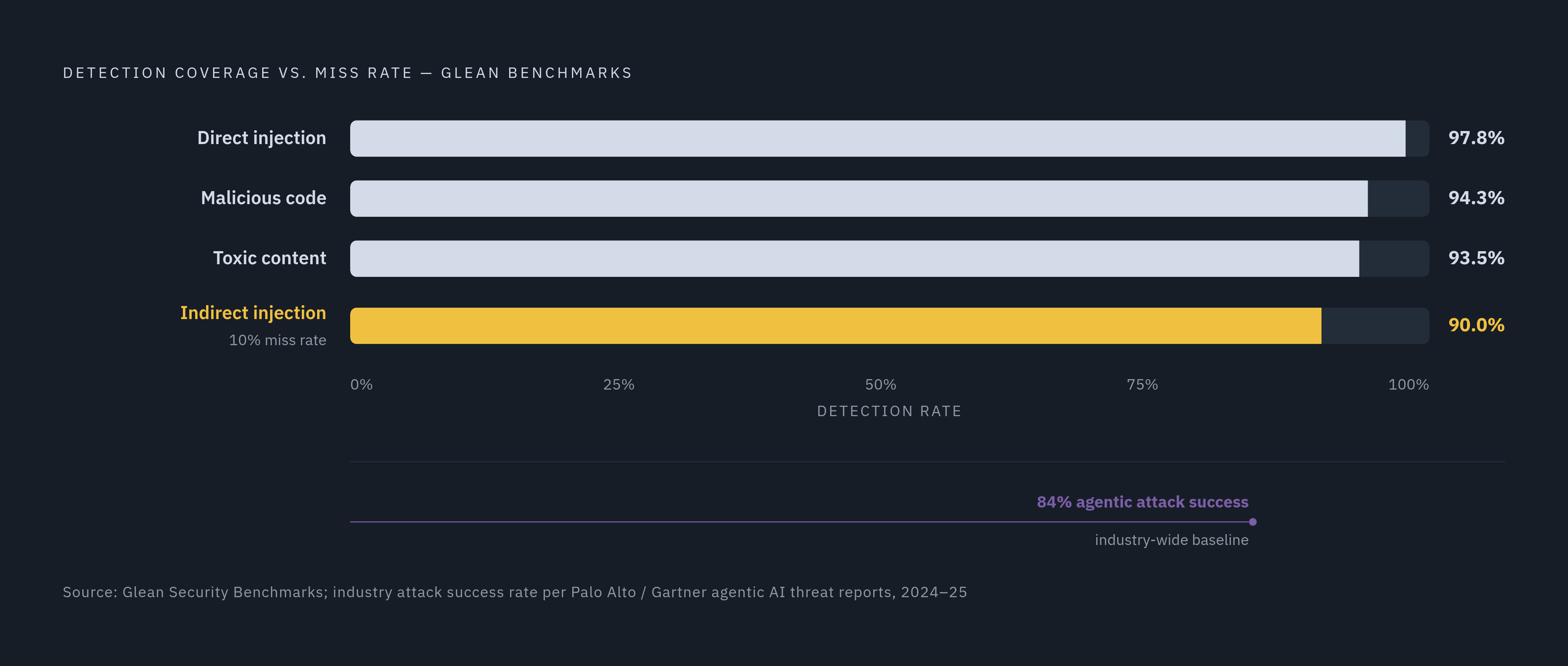
Prompt injection is ranked number one on the OWASP Top 10 for LLM Applications 2025, and attack success rates in agentic systems reach as high as 84%. Some production exploits carry CVSS scores above 9.0. That's the backdrop against which any vendor's detection numbers need to be read.
Glean published its own detection figures on September 5, 2025, and similar numbers appear on its current security page. Direct prompt injection detection is 97.8% in the September 2025 benchmark, with the current site showing 96.9%. Indirect prompt injection detection is 90%. Toxic content detection is listed at 93.5%, malicious code detection at 94.3%, and unstructured data scanning at 95%.
Every one of these numbers is self-reported, measured on Glean's own benchmark, and published on Glean's own marketing pages. No independent third-party audit of these figures appeared anywhere in the research behind this piece. That doesn't make the numbers false; it does mean they should be read as a starting claim, not a settled fact. It does mean they should be read as a starting claim, not a settled fact.
Even taking the 97.8% direct injection number at face value, that leaves a 2.2% miss rate. Run that against billions of queries at enterprise scale, and 2.2% stops looking like a rounding error and starts looking like a real, ongoing exposure surface. Indirect injection is the tougher case anyway: 90% claimed detection sitting against an 84% industry-wide attack success rate in agentic systems is a narrow margin, and indirect injection, smuggled in through a retrieved document or an external data source, represents a particularly serious and growing threat to agentic AI systems.
Regulatory pressure sharpens the stakes further. Prompt injection maps onto multiple major security and regulatory frameworks, including OWASP and ISO 42001. With EU AI Act obligations increasingly active, European deployments don't have the luxury of treating this as a someday problem. Any serious assessor should ask Glean for its benchmark methodology under NDA, treat the self-reported figures as a first data point rather than a compliance attestation, and layer in independent runtime monitoring anywhere agents are actually running in production.
Encryption, compliance certifications, audit logging, and SIEM integration: the controls auditors will check
On the technical basics, Glean uses AES-256 encryption at rest and TLS in transit. Customer data carries a unique tenant identifier through every stage of the pipeline, and query logs and feedback signals stay inside that same tenant context.
Glean's product page and trust portal list a solid stack of certifications: SOC 2 Type II, ISO/IEC 27001, ISO 42001, HIPAA, GDPR, and TX-RAMP Level 2. Swanum's independent review from July 2026 rated Glean "Enterprise-Ready," scoring it 93 out of 100 and confirming the SOC 2 and ISO 27001 certifications through the trust portal.
Certifications are useful, but they don't cover everything a buyer might assume they cover. SOC 2 Type II confirms that certain controls were designed correctly and operated as intended over the audit period, it says nothing specific about AI attack surfaces. ISO 42001, the AI management system standard, is genuinely rare to see and worth taking seriously, but its actual scope needs to be checked against the certificate itself rather than assumed from the name. And a HIPAA designation means Glean will sign a BAA. It doesn't mean every connector and every agent workflow has been separately validated for handling protected health information.
On logging, Glean runs real-time dashboards that record every query, every response, and the retrieval path behind it, timestamps, user identity, and query context included. Retention is set by the customer, typically somewhere between 30 and 365 days. That log data, along with access events and AI answer logs, can stream into a customer's own SIEM or SOAR setup. Glean also integrates with Tines for automated investigation and remediation of sensitive findings, including pulling back oversharing at the source, and partners with Palo Alto Networks through Prisma AIRS for AI runtime security, along with Cortex Cloud for data security posture management.
There's a bug bounty program running through Bugcrowd, and security issues can also be reported directly to security@glean.com. SOC 2 reports and other certifications are available under NDA through the Glean Trust Portal. Before signing off, an auditor should push on three specific things: which connectors were actually inside the SOC 2 audit scope, whether agent-driven actions get logged with the same detail as a plain search query, and whether the retention window Glean offers actually lines up with the organization's own regulatory requirements. None of that is guaranteed just because the certification badge exists.
Agentic workflows: why autonomous execution opens a distinct and larger attack surface than search
Search and agents are not the same risk category, even though they run on the same underlying platform. A search query returns information to a person, who then decides what to do with it. An agent skips that decision point. It reads, it reasons, and it acts, sometimes updating a record, sending a message, or triggering a downstream workflow without a person reviewing the output first.
That changes the failure mode. A bad search result is an inconvenience. A bad agent action is an event in which a document gets shared with the wrong group, a ticket gets closed incorrectly, or a message goes out that shouldn't have. The permission checks described earlier are necessary here, but they're not sufficient on their own, because permission answers "can this agent see the data," not "should this agent take this action based on what it saw." Those are two different questions, and Glean's own agent alignment models, the ones still in beta, exist specifically to try to answer the second one.
Indirect prompt injection becomes more dangerous in this context too. A search assistant that gets tricked by a malicious instruction hidden inside a document might return a wrong or manipulated answer. An agent that gets tricked the same way might act on that answer, and the consequence lands somewhere in a live system rather than staying contained in a chat window. That 90% detection figure for indirect injection matters a great deal more once the thing on the other end of a missed detection can actually do something, rather than just say something.
None of this means agentic workflows should be avoided. It means the review process for an agent needs to be its own process, distinct from the review process for search, and pegged to the specific actions that agent is allowed to take. What can it touch? What can it change? Who reviews what it did, and how quickly? Those questions don't have generic answers, and they shouldn't be treated as already answered just because the underlying platform has a strong permission model and a set of security certifications. The permission model is the floor. Agent governance is the part still being built on top of it, in beta, in real time, while enterprises decide how much autonomy to hand over before the guardrails are fully in place.